
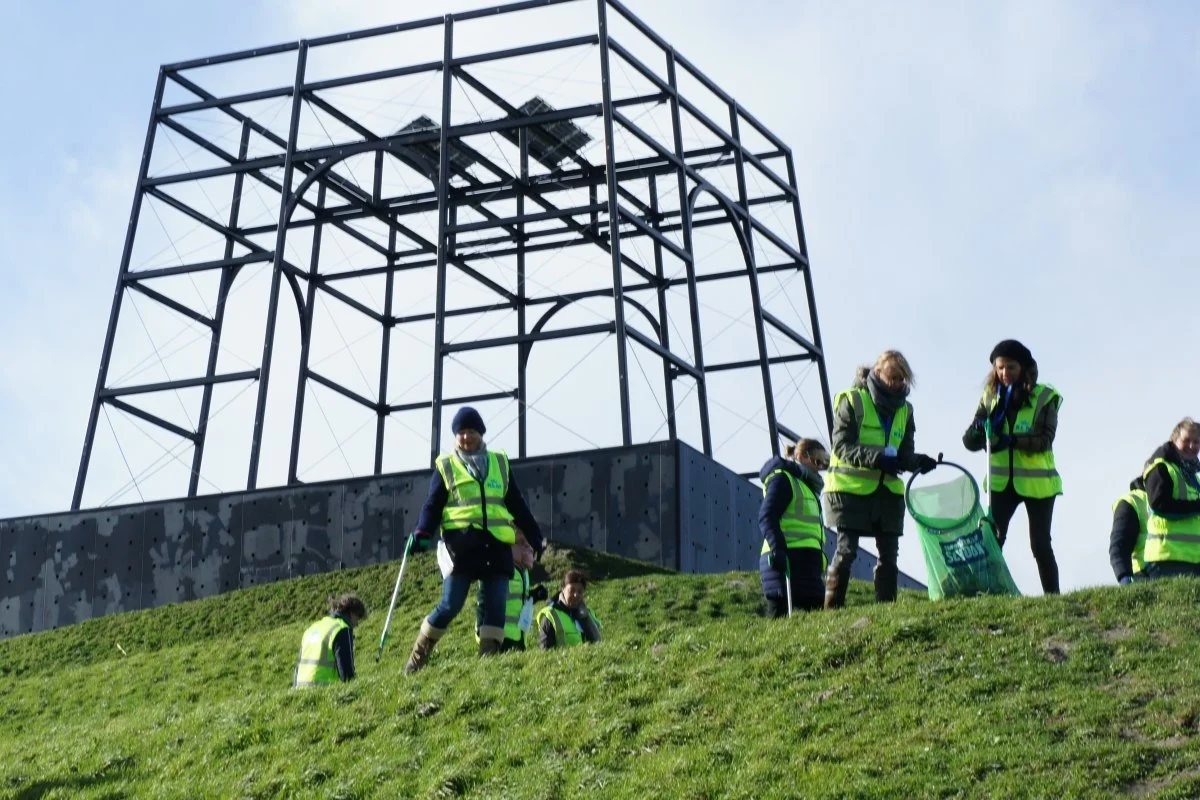
As part of its corporate social responsibility (CSR) efforts, KLM employees are cleaning up a substantial amount of litter this week at the Mysteryland festival grounds near Hoofddorp. A total of 200 KLM volunteers, working in various teams, are digitally mapping the litter as they clean it up. In the coming period, the litter will be visualized by NMCX Center for Sustainability through a new digital project called “Wastelab.” This initiative is based on Citizen Science, in which data collected by citizens helps predict, for example, waste streams.
By recording the type of litter and its location, volunteers are helping to ensure efficient litter management in the future. “By collecting data with residents, businesses, schools, and community organizations, we gain a better understanding of what’s out there, how much of it there is, and where it comes from. With that information, we can tackle litter more efficiently. In this way, we’re already helping various municipalities to better combat litter, predict its occurrence, and clean it up more efficiently,” said Virgil Bawits, project manager at NMCX.
Smart City Data Leads to Efficiency
The WasteLab project involves, among other things, the use of digital technologies that enable NMCX to visualize litter—both online and offline. The long-term goal is to predict hotspots and the movement of (plastic) litter in cities and, above all, in (surrounding) natural areas. The ultimate goal on the horizon is to predict the behavior of litterers using Big Data.
NMCX expects that the increase in available data will help municipalities predict more accurately where (plastic) litter accumulates. This will allow (plastic) litter to be removed more efficiently by machine and waste containers to be placed more effectively. Cleaning routes can also be planned more intelligently. This allows municipalities to maximize the results of their cleanup efforts and reduce CO2 emissions from the cleaning process.
"By using data in a sustainable way to digitize litter, a digital trail left behind by people is created. If you then visualize and share that data, residents can also make better decisions on their own about what they can do to prevent litter. In this way, visualizing the data ensures that residents contribute in their own way to a cleaner living environment and natural areas. Municipalities, too, can approach solutions and citizen participation in a completely different way. Incidentally, NMCX is investigating how citizen data can also be used for other sustainability issues—such as locations experiencing heat stress, air pollution, or flooding. “It is precisely this kind of participation that NMCX stands for,” concludes Arjanne Lagendijk, director at NMCX, Center for Sustainability.